Nick Chaiyachakorn
chaiyach@ohsu.edu (academic CV tbd)
MS Biostatistics candidate
Oregon Health and Science University, School of Public Health
A bit about me.
I am a quantitative researcher in the applied social and health sciences. I currently have the privilege of doing autism research in both community-participatory and epidemiological contexts. For fun, I take too many quantitative methods courses. (My graduate program directors can testify to the headaches I've given them!)
I believe the most original research comes from interdisciplinary work within the social and health sciences, and dialogue between their statistical lenses, despite differences in language.
I aspire to be a statistical polyglot. So I've spent a lot of my career building a wide statistical toolbox. I've had the privilege to work with/learn from from social psychologists, survey statisticians, psychometricians, high-performance computing engineers, geostatisticians, and epidemiologists. If you need an applied statistician in the social sciences, do reach out to the email above!
My statistical toolbox
As people collect visas to countries, I collect (and cherish) I've had the privilege of talking my research mentors into letting me doing the following types of analyses:
| Structural equation modelling – exploratory/confirmatory factor analysis, multi-group SEM, longitudinal models, growth curve analysis | ...on healthcare patient survey datasets |
| Multilevel/hierarchical/mixed effects modelling | ...on high-school/post-high school educational attainment data |
| Analysis of survey sample data (e.g. multi-stage stratified/clustered samples) | ...on public sector survey research at ...on epidemiological surveillance data (e.g. National Survey of Children's Health) |
| Latent variable methods in general – e.g. latent class and trajectory/transition analysis | ...on healthcare accommodations data |
| Psychometrics and psychological scale/instrument validation | ...on patient-reported outcome measures developed by and for autistic community members |
These are things I've learned in graduate-level classes, and wish I could use more in real life...
| Longitudinal models with separate cross-sectional and longitudinal effects (ahoy there Lord's Paradox!) | |
| Matching methods for causal analyses (the types epidemiologists do) | |
| Spatiotemporal modelling (co/variogram analysis and kriging, generalized additive models) | ...on spatiotemporal ad auction data |
| Survival/time-to-event analysis (proportional hazards models, mostly) | ...on breast cancer cohort study data |
One day, I'll learn...
| Complex survey weighting methods (raking) | ...like the pollsters do! |
| Advanced design of experiments – the type that industrial statisticians use | ...like the local statisticians at Intel do! |
Writing
I learn things by writing them up. Unfortunately, since grad school is killing me, I don't have a lot of time to wring things up. Nevertheless, here are some of the things I've been learning recently.
Trauma-informed care principles can be adapted for youth with autism. AAP News. (2005-12-01)
Unfortunately paywalled! Me and a research mentor, Dr. Katharine Zuckerman, co-authored a mini "op-ed" in the newsletter of the American Academy of Pediatrics about how autistic kids in crisis can be treated better by pediatric urgent care providers and hospitals.
A great deal, if not all, of these is true for autistic adults, and adults with disabilities in general.
Pediatricians are awesome. This benefitted heavily from the experiences of Dr. Zuckerman and her pediatrician colleagues who have thought a great deal about trauma-informed care of kids with autism (and other disabilities); especially those who experience crisis a great deal.
Geometric interpretation of the OLS estimator (2025-04-02)
Reminder to myself about the geometric intuition behind the OLS estimator as a projection operator, and its associated standard error.
Coding
School keeps me busy, so to distract myself I do small non-statistics related utilities, mostly for command-line applications.
color-detection-diagnostic.c
Mini-utility exercising multiple methods to determine terminal colour capabilities on *nix platforms - environment variables, 'ncurses', xterm-style Primary/Secondary Device Attribute queries, true-colour roundtripping, a visual demo, and process name detection.
libfixmathmatrix
A header-only (+ optional source file) amalgamation of a 32-bit fixed-point numerics and linear algebra library.
Cool miscellany
Print alignment/printable bounds test page (letter-size)
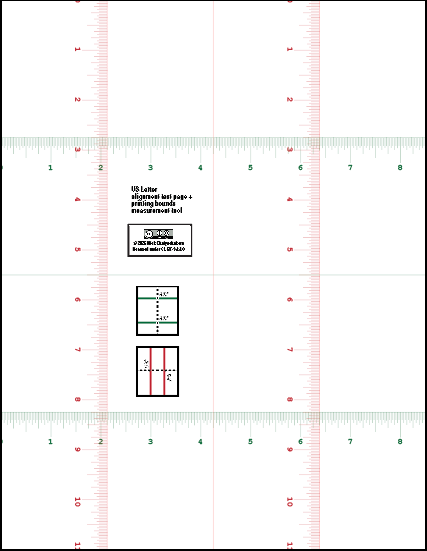 Have a questionable printer? Want to figure out how exactly the image on your computer screen
actually gets mapped to a physical page? Need to detect whether your pages print misaligned, or need to
determine what parts of the printed page get cut off? Look no further!
Have a questionable printer? Want to figure out how exactly the image on your computer screen
actually gets mapped to a physical page? Need to detect whether your pages print misaligned, or need to
determine what parts of the printed page get cut off? Look no further!
Print this test page out at a 1:1 ratio. To determine alignment, fold the page horizontally and vertically, and measure where the creases cross the horizontal and vertical rulers. To determine where the printing bounds end (assuming that the page is being printed 1:1), look at where the horizontal and vertical rulers get cut off.
Exercise for the reader: correct for misalignment on your computer, without adjusting the printer.
Mirror: M1 Exploration - v0.70, Maynard Handley
Have you barely learned what a superscalar processor is? Have you always wondered how modern microprocessors actually keep track of instructions "in flight"? Here's an old document by Maynard Handley providing a surprisingly accessible nuts-and-bolts description of the microarchitecture of Apple's M1.
This was circulating on the internet around 2021 via a single Google Drive link, but disappeared a while ago. To preserve it for posterity, I mirror it here.
Research mentors I've been privileged to have
I'm indebted to so many kind people who've given advice to me, especially during rough times. Here, I'll limit myself to the academic mentors who I've had sustained relationships with for many years. They've kept me going rough times and the precarity of research. Alphabetical order:
-
Debi Elliott (Portland State University,
Regional Research Institute)
- Christina Nicolaidis (Portland State University, Academic Autism Spectrum Partnership in Research and Education)
- Katharine Cahn (emerita, Portland State University, Center for Improvement of Child and Family Services)
- Katharine Zuckerman (Oregon Health and Science University, Pediatrics)
- Lisa Steinman (emerita, Reed College)
- Mathew Uretsky (Portland State University, School of Social Work)